
5 Ways Industrial Plants Can Reduce Freshwater Consumption
Cooling towers quietly drink more water than almost anything else in your plant. Here is where it goes, and how to take it back.
Where does a plant's freshwater go?
Illustrative split for a typical process plant. Actual shares vary by industry and site.
Freshwater is essential for industrial operations and is used in cooling systems, manufacturing processes, utility operations, cleaning, steam generation and other plant activities. As industrial water consumption and freshwater demand continue to increase, securing additional water supplies is not always a sustainable solution.
Industrial plants can reduce freshwater consumption by optimizing cooling tower operation, controlling blowdown, reusing suitably treated wastewater, recovering water from other plant streams and maintaining a clear industrial water balance. For facilities facing high TDS cooling tower blowdown, treatment and recovery can further reduce freshwater demand and wastewater disposal volumes.

Here are five practical ways industrial plants can reduce their dependence on freshwater.
1. Optimize Cooling Tower Water Consumption
Cooling towers are among the major water consuming systems in many industrial plants. Water is mainly lost through evaporation, blowdown, and drift.
While evaporation is necessary for heat removal, blowdown is used to control the concentration of dissolved and suspended constituents in the circulating cooling water. Therefore improving cooling tower operation can create a significant opportunity for freshwater conservation.
Reducing unnecessary blowdown can therefore reduce the amount of makeup water required.
Optimize Cycles of Concentration
COC indicates how many times dissolved constituents have concentrated in the circulating cooling water compared with the makeup water.
Operating at a higher COC can reduce blowdown and makeup water requirements. However increasing COC proper control of scaling, corrosion, and biofouling can create operational problems.
Parameters such as TDS, hardness, alkalinity, silica, chlorides, sulphates, pH, TSS and biological activity should be evaluated when considering higher COC operation.
2. Reuse Suitable Treated Wastewater Inside the Plant
Industrial plants generate wastewater from different operations such as manufacturing, cooling, cleaning, utilities, and water treatment. Depending on its quality this water can be treated and reused for cooling tower makeup, utility water and other suitable plant requirements.
Sources include ETP treated wastewater, RO reject, cooling tower blowdown, process condensate, boiler blowdown, WTP backwash and suitable CIP wastewater.
However not every wastewater stream can be reused directly. The water quality needs to be checked against the requirements of the application. Parameters such as TDS, hardness, alkalinity, chlorides, sulphates, silica, pH, COD, BOD, TSS.
3. Reduce Cooling Tower Blowdown
Cooling tower blowdown is another important area where industries can reduce freshwater consumption. Whenever a portion of the circulating cooling water is discharged as blowdown it needs to be replaced with makeup water. If freshwater is used as makeup, higher blowdown means higher freshwater consumption.
A simple relationship is:
As COC increases dissolved salts and other constituents become more concentrated which can increase the risk of scaling, corrosion, biofouling and suspended solids accumulation.
Therefore the focus should be on optimizing blowdown while maintaining suitable cooling water This becomes especially important when industries want to use higher TDS water as cooling tower makeup.
Raise COC, shrink the drain
Blowdown per 100 m³ of water evaporated
Blowdown = Evaporation ÷ (COC − 1), ignoring drift.
Estimate your blowdown at a higher COC
Enter your cooling tower numbers to see how blowdown changes as COC rises. This uses the standard relationship, blowdown = evaporation ÷ (COC - 1), and ignores drift.
Indicative only. Actual results depend on makeup water quality and on controlling scaling, corrosion and biofouling.
4. Build an Industrial Water Balance
An industrial water balance helps plants understand where water is consumed, where wastewater is generated and where recovery opportunities exist.
By mapping these flows, industries can identify major water-consuming operations and prioritize opportunities to reduce freshwater consumption.
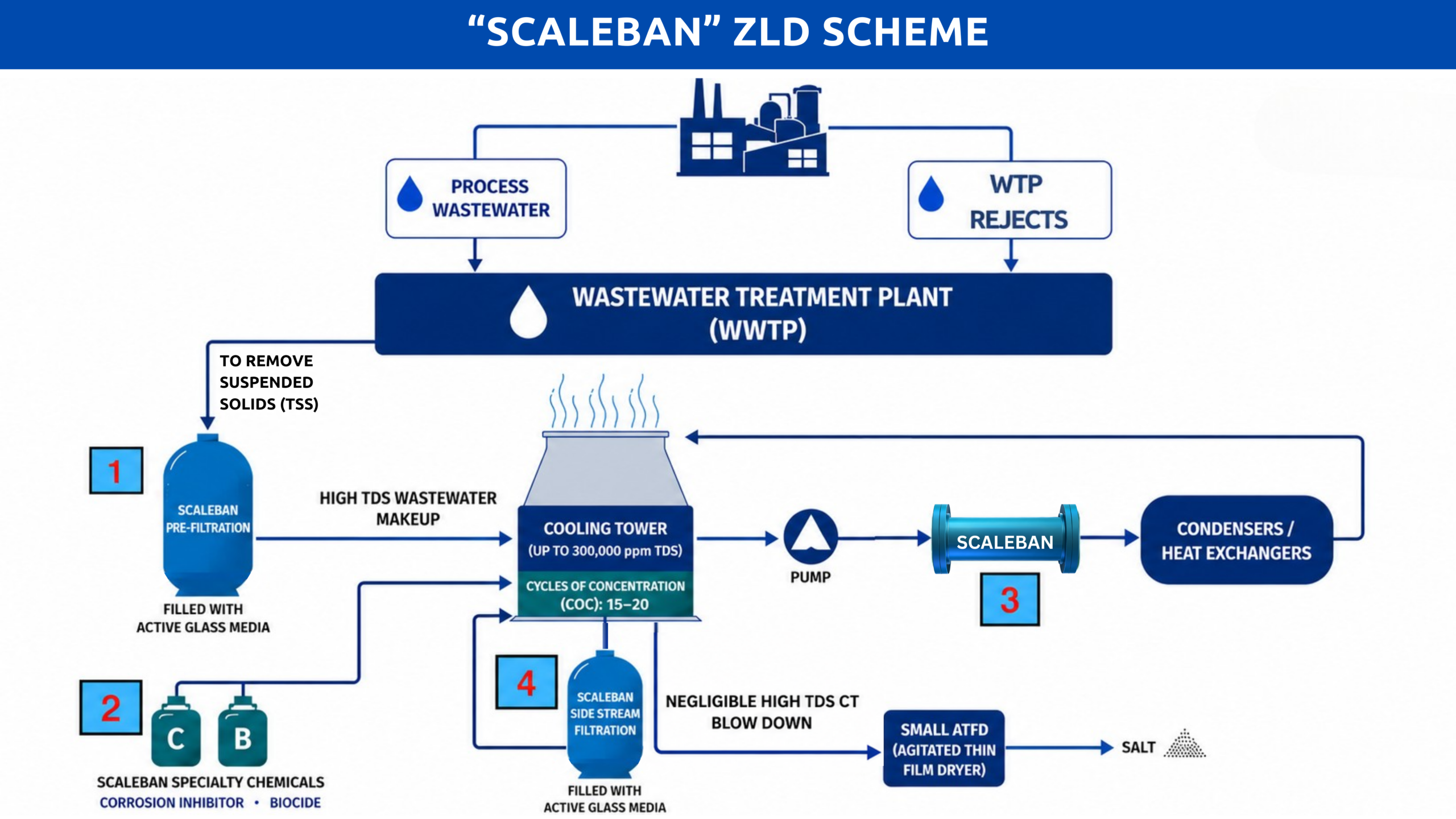
5. How SCALEBAN Reduces Freshwater Consumption
SCALEBAN combines equipment, specialty chemicals and filtration to enable the controlled reuse of suitable high TDS wastewater as cooling tower makeup water while addressing key challenges such as scaling, corrosion, biofouling and suspended solids.
Wastewater streams such as RO reject and treated ETP water, with TDS levels of up to 300,000 ppm, can be evaluated for reuse as cooling tower makeup water.
By managing key cooling water challenges, SCALEBAN support COC levels of 15–20
Higher COC means less circulating water needs to be discharged as blowdown. SCALEBAN can achieve up to 90% reduction in cooling tower blowdown.
By reusing suitable high TDS wastewater and reducing blowdown SCALEBAN can help achieve up to 100% reduction in freshwater makeup
How the Approach Works
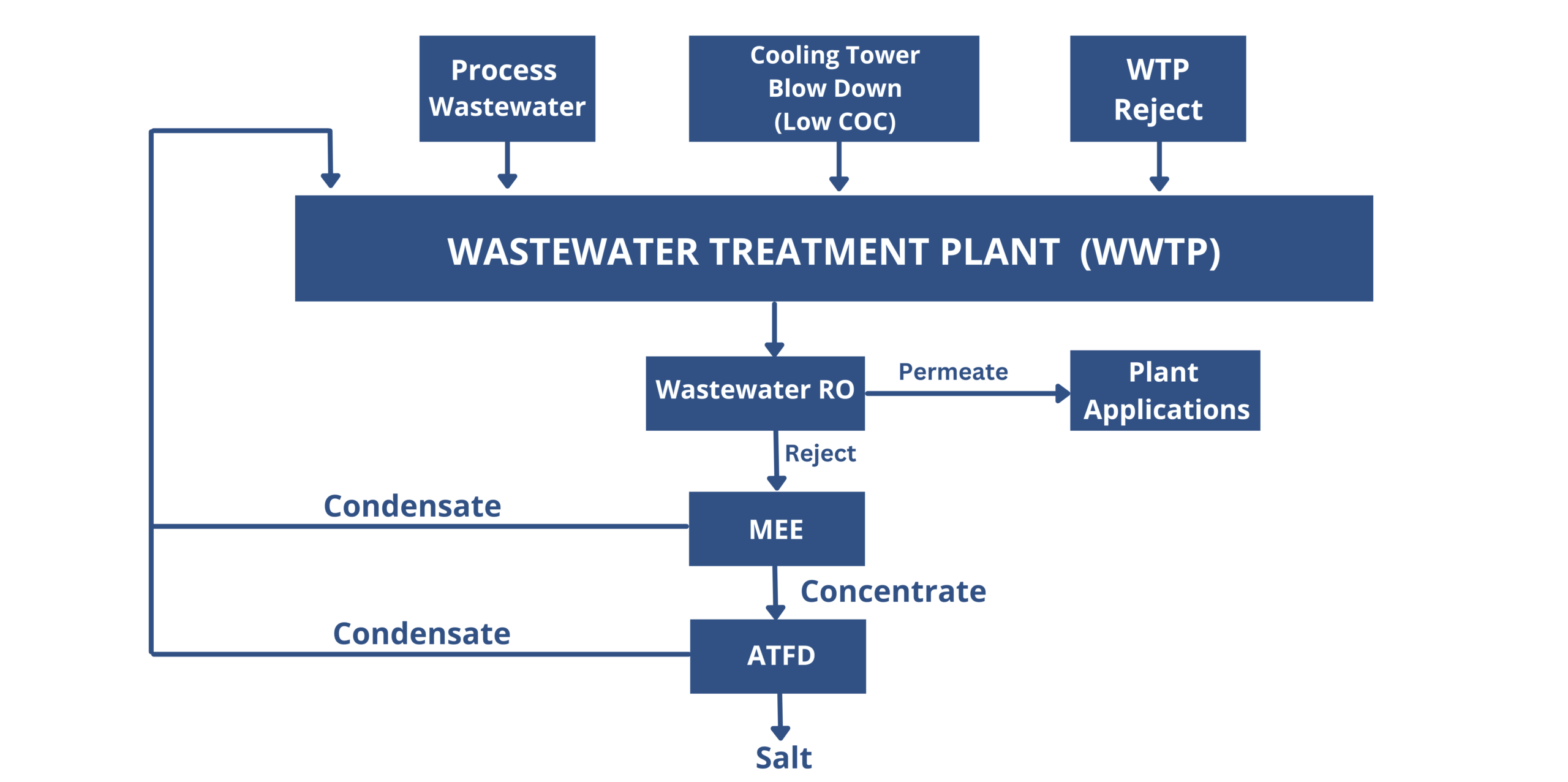
Conventional ZLD Scheme
SCALEBAN ZLD Scheme
Conclusion: Reducing Freshwater Consumption Starts With Better Water Management
Freshwater conservation in industrial plants is not simply about using less water. It is about understanding where water is consumed, where it is lost and where existing water streams can potentially be recovered and reused.
Cooling tower optimization, wastewater reuse, blowdown reduction and recovery from other industrial streams can all help reduce freshwater dependency. For plants generating suitable high TDS wastewater, reuse as cooling tower makeup can provide an additional opportunity to conserve freshwater.
Looking to reduce freshwater consumption in your industrial plant?
Explore how SCALEBAN can help you evaluate high TDS wastewater reuse and cooling tower water conservation opportunities.
Contact SCALEBAN
Looking to reduce freshwater consumption in your industrial plant?
Explore how SCALEBAN can help you evaluate high TDS wastewater reuse and cooling tower water conservation opportunities.