
Reverse Osmosis (RO) is widely used in industries to treat water and reduce dissolved salts for various applications. However the RO process also generates a concentrated stream known as Wastewater RO reject which contains a much higher concentration of dissolved salts than the feed water. Managing this high TDS stream can be a challenge for industries, especially when large quantities of Wastewater RO reject are generated.
Can high TDS Wastewater RO reject be reused in cooling towers?
Yes, in suitable industrial applications, it can be considered as a cooling tower makeup water source. However, successful reuse requires proper evaluation and control of water chemistry to manage challenges such as scaling, corrosion, biofouling and suspended solids.
Why Is Wastewater RO reject Difficult to Reuse in Cooling Towers?
Cooling towers operate by evaporating a portion of the circulating water to remove heat. As water evaporates dissolved salts remain in the system and become more concentrated. When high TDS Wastewater RO reject is used as cooling tower makeup the concentration of dissolved salts can increase further.
This can create several challenges that need to be properly managed:
1. Scaling
Calcium, magnesium and other dissolved minerals can form deposits on heat transfer surfaces Scaling can reduce heat-transfer efficiency and affect cooling system performance.
2. Corrosion
High concentrations of chlorides, sulphates and other dissolved constituents can increase corrosion risk depending on the water chemistry and metallurgy used in the cooling water circuit.
3. Biofouling
If the reused water contains biodegradable organic matter microorganisms can grow in the cooling water system. This can contribute to biological deposits and affect system performance.
4. Suspended Solids
Suspended solids in the makeup or circulating water can accumulate in the cooling water circuit if they are not properly controlled. This can affect water quality and increase the need for filtration and cleaning.
Therefore, simply adding high TDS Wastewater RO reject to a cooling tower is not a complete solution. The cooling-water system must be properly managed to control water chemistry, scaling, corrosion, biofouling and suspended solids.
Conventional Route to Treat Wastewater RO Reject
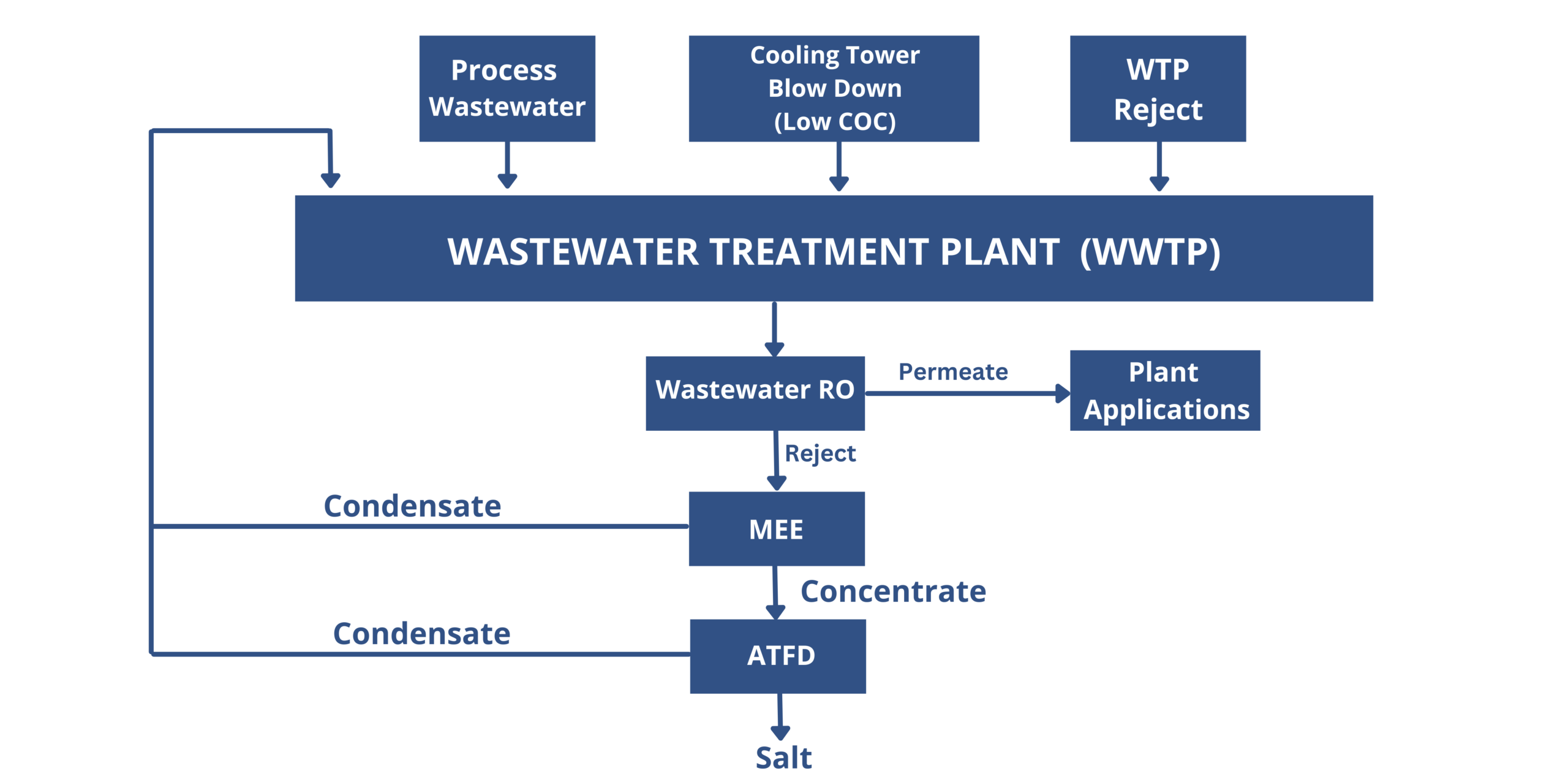
Illustrative Cost Comparison
Consider an industry generating 25 m³/day of RO reject
MEE Operating Cost
- RO Reject Generation: 25 m³/day
- MEE Operating Cost: ₹2,000/m³
- Annual Operation: 365 days
- Annual MEE Operating Cost: ₹1.825 crore/year
- MEE CAPEX: ₹1.5–2.5 crore
How to use high TDS Wastewater RO Reject in Cooling Towers
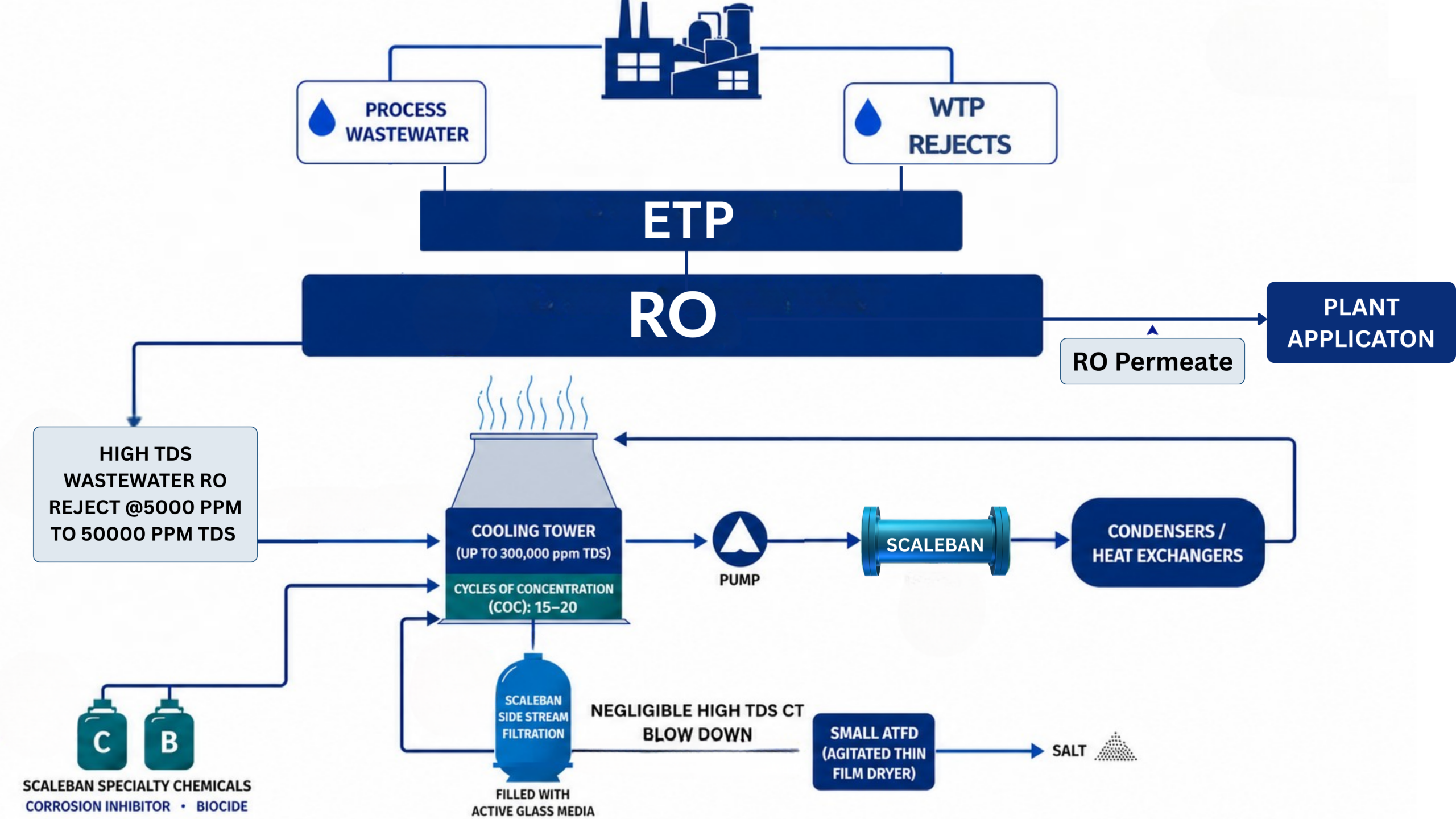
When using high TDS Wastewater RO Reject as makeup water in cooling towers four key concerns need to be addressed: scaling, corrosion, biofouling and TSS control. Let’s see how SCALEBAN addresses each of these concerns to enable the effective reuse of high TDS Wastewater RO Reject in cooling towers.
-
1. Hard Water Scaling
Scaleban equipment is a pipe shaped equipment that will be installed just at the inlet of every heat exchanger in the cooling water line which prevents scaling in the heat exchangers at very high hardness available in the cooling tower circulation water.
-
2. Corrosion
Scaleban speciality chemicals (Corrosion inhibitors) are suitably designed to control corrosion on the different metallurgy in the cooling tower circuit, at very high TDS, chlorides, sulphates in the cooling tower circulation water.
-
3. Bio Fouling
Scaleban Specialty chemicals (Biocides) are suitably designed to control biofouling in the cooling tower circuit with the use of wastewater having COD & BOD.
-
4. TSS Control
Scaleban pre-filtration system and side stream filtration (SSF) system having glass media in the cooling tower effectively remove suspended solids from both the makeup and circulating water.
Want to achieve ZLD at up to 80% lower CAPEX and OPEX?
Explore the SCALEBAN ZLD ApproachHow Does Wastewater RO reject Reuse Support ZLD?
In a conventional water treatment system Wastewater RO reject is often sent for further downstream treatment. However, when a suitable Wastewater RO reject stream can be reused as cooling tower makeup it can improve the overall plant water balance.
By reusing Wastewater RO reject within the cooling water system:
- The volume of wastewater requiring energy intensive treatment can decrease.
- The size and operating cost of ZLD systems can reduce.
- Reduces Freshwater dependency while improving sustainability and compliance.
For industries working toward Zero Liquid Discharge (ZLD) objectives, this can create an opportunity to reduce the load on conventional energy intensive treatment processes.
SCALEBAN supports water conservation and ZLD objectives by enabling the reuse of high TDS wastewater and reducing dependence on conventional technologies such as wastewater RO and MEE.
Ready to rethink ZLD beyond conventional RO and MEE by reusing Wastewater RO reject in cooling towers?
Discover the SCALEBAN ZLD Approach