
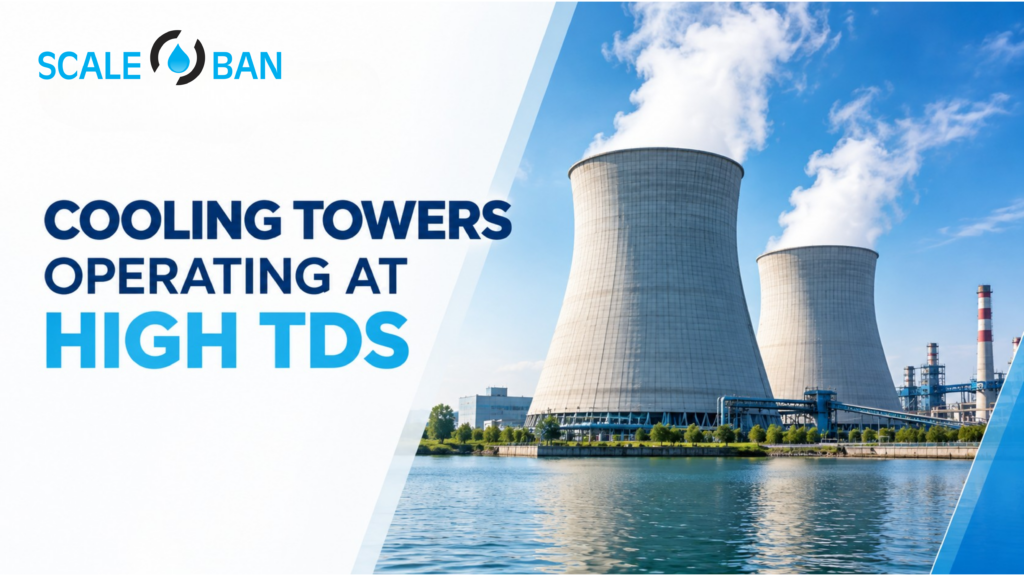
How Can Cooling Towers Run at High TDS Without Scaling?
Cooling towers remove heat through evaporation. As water evaporates dissolved salts and minerals remain in the circulating water causing Total Dissolved Solids (TDS) to increase.
For industries operating large cooling towers high TDS can become a major challenge. As dissolved solids become more concentrated the risk of mineral deposition and scaling on heat transfer surfaces can increase.
What Happens When TDS Increases in a Cooling Tower?
In a cooling tower evaporation removes water but leaves most dissolved solids behind.
The process is simple:
Evaporation → TDS concentration increases → Mineral concentration increases → Scaling risk increases
When certain minerals exceed their solubility limits they can precipitate and form deposits on heat exchangers and other surfaces.
This is why cooling tower operators traditionally use blowdown to remove concentrated water and replace it with makeup water. However, frequent blowdown also means higher water consumption and increased wastewater generation.
Why Is High TDS a Challenge for Cooling Towers?
High TDS does not automatically mean scaling. The actual risk depends on the composition of the cooling water and operating conditions.
Parameters such as calcium, magnesium, alkalinity, chlorides, sulphates, silica, pH and temperature can influence mineral precipitation and scale formation.
Therefore successful high TDS cooling tower operation requires more than simply increasing the TDS or conductivity limit. The key is to maintain the water chemistry while controlling the tendency of dissolved minerals to form hard deposits.
Why Do Cooling Towers Use Blowdown?
Blowdown is a conventional method of controlling dissolved solids.
A portion of concentrated circulating water is discharged and replaced with makeup water. This keeps dissolved solids within an acceptable operating range.
The relationship is commonly expressed through Cycles of Concentration (COC):

Higher COC means water can remain in the cooling system for longer, reducing blowdown and makeup water requirements. However higher concentration also makes effective scale control increasingly important.
This creates a common operating challenge:
Lower TDS → Lower scaling risk → More blowdown
Higher TDS → Less blowdown → Greater scaling challenge
The opportunity is to operate at higher TDS without allowing scale to affect cooling performance.
How SCALEBAN helps Cooling Towers Run at High TDS Without Scaling?
SCALEBAN is designed to manage both water chemistry and scaling tendency so that cooling towers can operate reliably at higher TDS.
Operate at higher TDS → Control scaling → Increase COC → Reduce blowdown
SCALEBAN offers a non-conventional approach to industrial water and wastewater management designed to help industries utilize suitable high-TDS water in cooling towers while controlling scaling.
How SCALEBAN addresses following concerns while operating cooling tower with wastewater at High TDS/High COC — TDS up to 300,000 ppm
SCALEBAN combines equipment, specialty chemicals and filtration to address the key challenges associated with high-TDS cooling water.
1. Hard Water Scaling
Scaleban equipment is a pipe shaped equipment that will be installed just at the inlet of every heat exchanger in the cooling water line which prevents scaling in the heat exchangers at very high hardness available in the cooling tower circulation water.
2. Corrosion
Scaleban speciality chemicals (Corrosion inhibitors) are suitably designed to control corrosion on the different metallurgy in the cooling tower circuit, at very high TDS, chlorides, sulphates in the cooling tower circulation water.
3. Bio Fouling
Scaleban Specialty chemicals (Biocides) are suitably designed to control biofouling in the cooling tower circuit with the use of wastewater having COD & BOD.
4. TSS Control
Scaleban pre-filtration system and side stream filtration (SSF) system having glass media in the cooling tower effectively remove suspended solids from both the makeup and circulating water.
Conclusion
High TDS does not have to mean unavoidable scaling.
The real challenge is managing the water chemistry and preventing dissolved minerals from forming deposits on critical cooling surfaces.
With the right scale control and water management approach, industries can explore high-TDS cooling tower operation, higher COC and reduced blowdown.
SCALEBAN’s non-conventional approach is designed to help industries utilize suitable high-TDS water while supporting reliable cooling-tower performance and better water conservation.