
Dubai is a rapidly growing industrial and commercial hub where efficient water management is becoming increasingly important. With limited natural freshwater resources, the UAE relies heavily on desalination to meet its water needs. At the same time, the country is placing greater focus on water conservation and the reuse of treated Wastewater.
For industries, this creates an important opportunity: wastewater should not always be viewed only as a waste stream. Suitable Wastewater can also become a potential source of reusable water.
The UAE Water Security Strategy 2036 aims to increase the reuse of treated water to 95% highlighting the growing importance of water reuse as part of the country's long term water management approach.
For industrial facilities in Dubai, the focus is therefore shifting from simply treating wastewater to finding safe and practical ways to reuse water within the plant.

Looking for a smarter approach to industrial wastewater reuse? Explore SCALEBAN’s ZLD Approach
The Challenge of Reusing Industrial Wastewater
Reusing industrial wastewater is not as simple as sending treated water back into the plant. The quality of wastewater can vary depending on where it comes from and how it has been treated.
Parameters such as TDS, hardness, alkalinity, silica, COD and suspended solids can affect whether a Wastewater stream is suitable for reuse. At higher concentrations, these can also increase the risk of scaling, corrosion and biofouling particularly in cooling water systems.
This is why industries need to look beyond Wastewater treatment alone. Understanding the quality of each Wastewater stream and where it can be safely reused is an important part of effective industrial water management.

Cooling Towers: An Opportunity for Water Reuse
Freshwater Reduction
Cooling towers require a continuous supply of makeup water to replace water lost through evaporation and blowdown. This creates an opportunity for industries to reuse suitable treated wastewater instead of depending entirely on freshwater.
Wastewater Reuse
Water streams such as RO reject and treated ETP water can be evaluated for reuse in existing cooling towers, depending on their quality and the operating conditions of the plant.
Efficient Water Management
With proper water management, industries can improve water-use efficiency, reduce freshwater demand and minimise cooling tower blowdown.
Want to reduce freshwater consumption in cooling towers? Explore SCALEBAN’s Water-Saving Approach
SCALEBAN’s Approach to Industrial Water Reuse
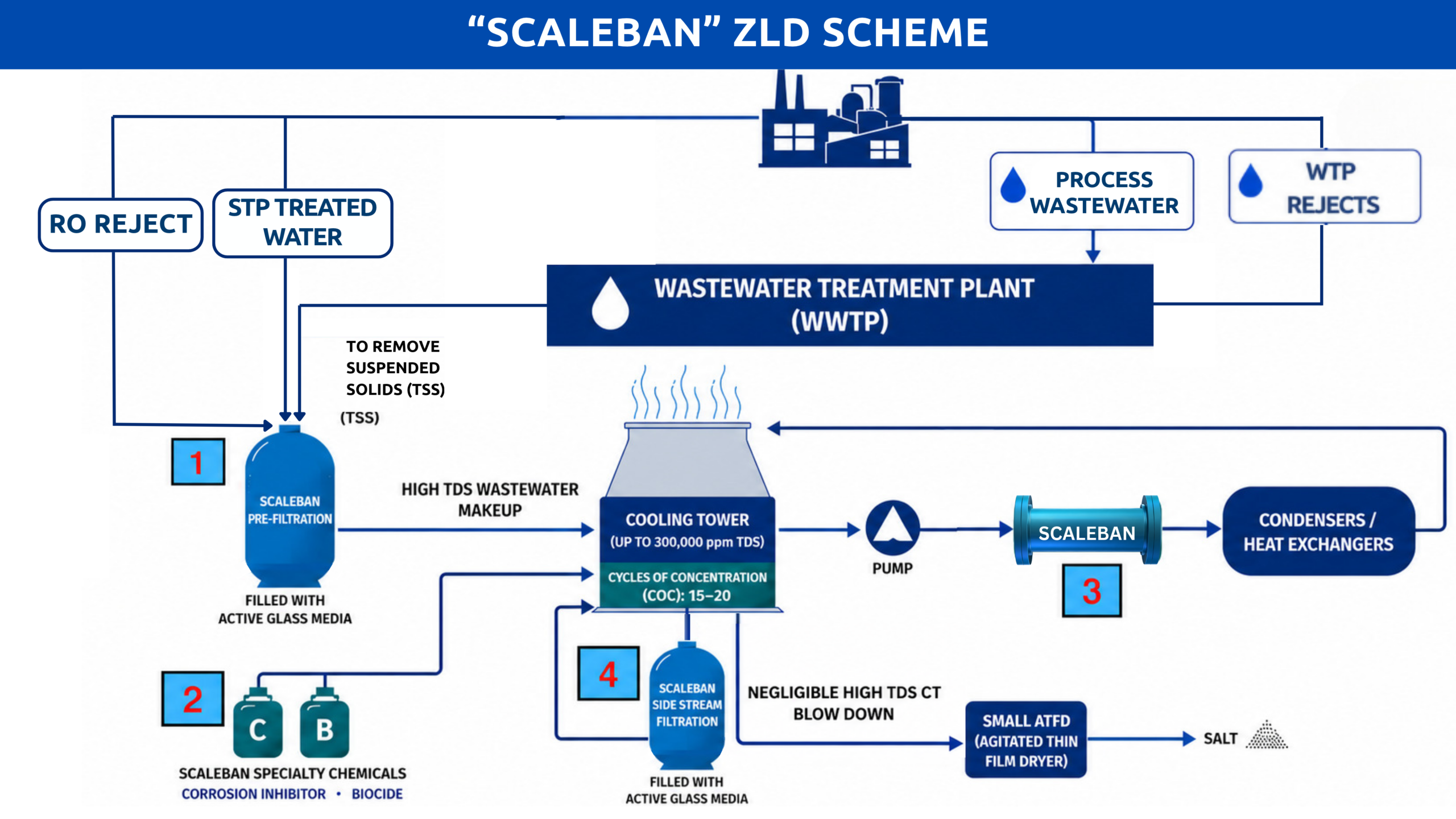
“SCALEBAN” solution is a combination of “SCALEBAN” Equipment, “SCALEBAN” specialty chemicals and “SCALEBAN” Filtration system by which wastewater such as RO reject & ETP treated water can be successfully utilized directly in cooling towers in place of fresh water without affecting the plant performance.
By integrating the “SCALEBAN” solution in the cooling tower circuit, the system can be operated at very high TDS upto 250000ppm (25%) by ensuring ZERO scale, corrosion and bio-fouling free operations of the entire cooling tower circuit.
The “SCALEBAN” solution enables the cooling tower to operate at a high Cycle of Concentration (COC) of 15–20, significantly reducing blowdown up to 90%. This results in a substantial reduction in makeup water demand and minimizes wastewater generation at the plant.
Looking for ways to reduce wastewater discharge and recover more water? Explore SCALEBAN’s approach to industrial ZLD.
Key Benefits of Industrial Water Reuse
Reusing suitable industrial wastewater can offer several benefits to industries in Dubai:
- 💧Reduced Freshwater Consumption: Reusing wastewater reduces the need for freshwater in cooling tower operations.
- ♻️Lower Wastewater Discharge: Reuse can help reduce the volume of wastewater that needs further treatment or disposal.
- 📉Up to 90% Reduction in Cooling Tower Blowdown: SCALEBAN approach can help reduce cooling tower blowdown by up to 90%
- 🏭Better Utilisation of Existing Water Streams: Industries can make better use of wastewater already generated within their facilities.
- 🌍Reduced CO₂ Emissions: Eliminating the need of energy intensive wastewater treatment and reduced freshwater demand can help reduce associated carbon emissions.
- 🎯Support for Sustainability Goals: Water reuse can contribute to responsible water management and the UAE’s broader water security objectives.
- 💰80% savings in CAPEX & OPEX over conventional technologies
- 🔁High COC (20) Operation: Enables cooling towers to operate at higher cycles of concentration.
- ⚡Energy-Free Operation: No additional energy requirement for SCALEBAN’s operation.
Conclusion: Moving Towards Sustainable Industrial Water Management
As Dubai continues to grow, efficient water management will remain important for its industrial sector. Reusing suitable industrial wastewater offers an opportunity to conserve freshwater, reduce wastewater discharge and improve overall water efficiency.
By adopting practical water reuse solutions, industries can make better use of available water resources while supporting the UAE’s long term water sustainability goals.