Industrial wastewater treatment is no longer just an environmental compliance requirement. It is also a significant financial consideration for industries facing high water consumption, energy intensive treatment processes and wastewater management costs.
For plants in sectors such as pharmaceuticals, chemicals, agrochemicals and manufacturing, achieving Zero Liquid Discharge (ZLD) can require substantial investment in treatment equipment and ongoing operating costs. The real challenge is not simply treating wastewater—it is finding a financially sustainable way to recover and reuse water.
Why Does Industrial Wastewater Treatment Cost So Much?
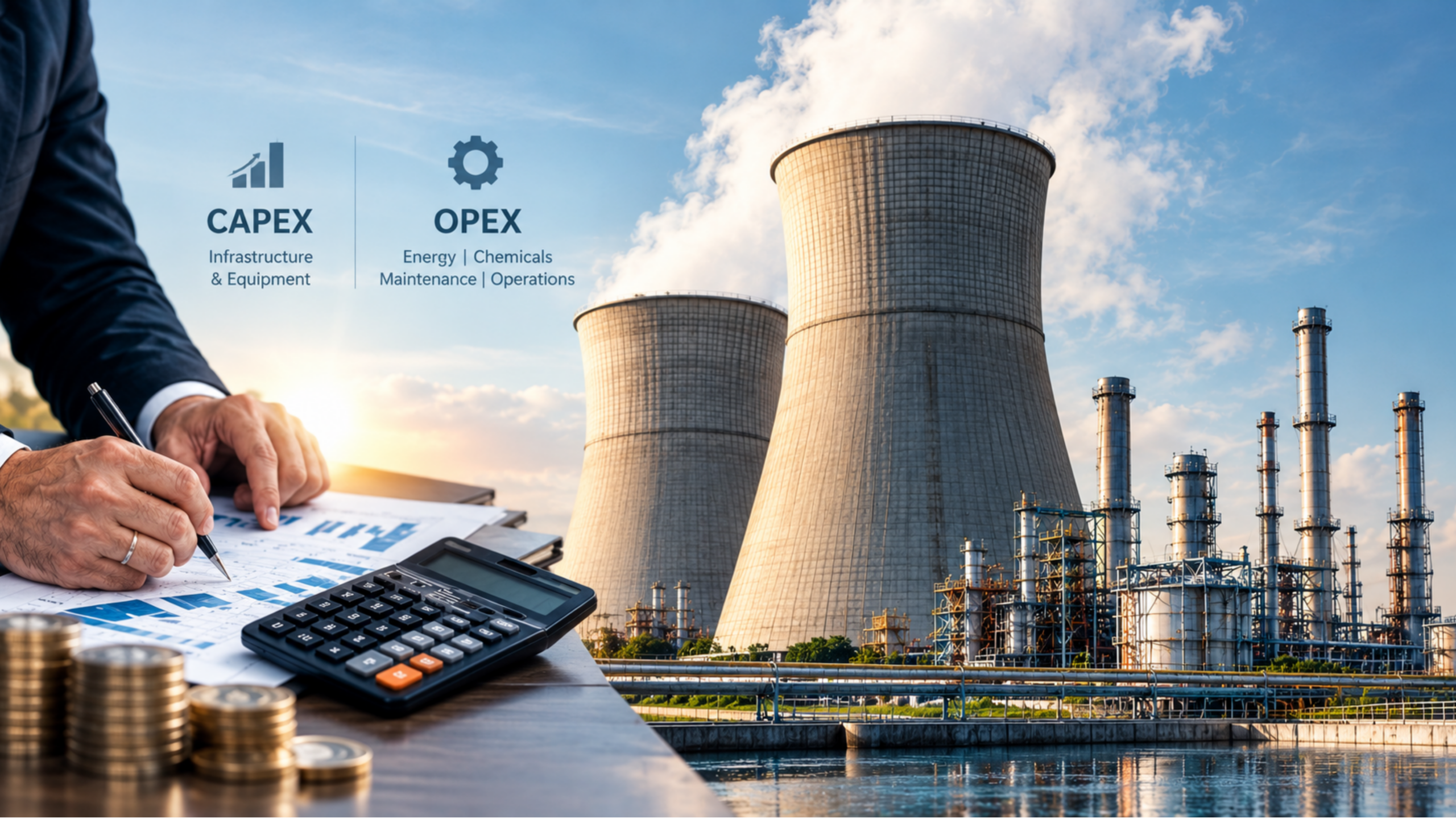
The cost of an industrial wastewater treatment system is largely influenced by two major components: Capital Expenditure (CAPEX) and Operational Expenditure (OPEX).
CAPEXCAPEX includes the initial investment in equipment, civil works, installation, piping, electrical systems and commissioning.
OPEXOPEX covers the recurring expenses required to operate the treatment system, including electricity, steam, chemicals, membranes, maintenance and residual waste management.
While CAPEX creates the initial financial burden, rising OPEX can continue to affect plant profitability throughout the system’s operating life.
The Hidden Financial Burden of Conventional ZLD
Conventional ZLD systems include wastewater reverse osmosis (RO), with thermal treatment technologies such as Multiple Effect Evaporation (MEE), with downstream processes such as Agitated Thin Film Drying (ATFD) or crystallisation. These processes increase energy consumption and overall treatment costs.
Energy needed to operate: Conventional ZLD vs SCALEBAN
RO
30%
MEE
74%
ATFD / Crystalliser
92%
SCALEBAN
0% · Zero energy to operate
Illustrative relative energy index (RO 30%, MEE 74%, ATFD / Crystalliser 92%, SCALEBAN 0%). Conceptual illustration, not measured plant data.
While RO is generally less energy intensive than thermal evaporation, treating large volumes of RO reject or high TDS wastewater through thermal processes increases operating expenditure (OPEX).
As a result, the financial evaluation of ZLD should go beyond the initial equipment investment. Industries need to consider the full operating lifecycle, including energy consumption, maintenance cost and the volume of wastewater requiring intensive treatment.
Can suitable wastewater be reused before it reaches energy-intensive downstream treatment stages? This is an important consideration when exploring ways to reduce the overall cost of industrial water management.
CAPEX vs OPEX: A Lifecycle Perspective
The initial investment is only one part of the total cost of industrial wastewater treatment. Energy consumption, maintenance and ongoing treatment requirements also influence the long-term financial burden.
Conventional RO + MEE + ATFD/Crystalliser vs. SCALEBAN’s Zero-CAPEX Approach
Conventional ZLDSCALEBAN Zero-CAPEX
Conceptual infographic to show cost structure, not actual project figures.
Conventional ZLD systems typically require upfront investment in treatment equipment and infrastructure, followed by recurring expenses for energy, chemicals, maintenance and residual management.
SCALEBAN’s Zero-CAPEX model allows clients to adopt the solution without upfront capital investment through a savings sharing model. By reusing suitable industrial wastewater, the approach can help reduce freshwater demand and dependence on energy intensive downstream treatment stages.
SCALEBAN’s Zero CAPEX Approach to Industrial Water Conservation
SCALEBAN offers an alternative approach to industrial water conservation by combining wastewater reuse with a Zero CAPEX, savings sharing model. Its integrated solution is designed to help industries reduce freshwater consumption and the burden of wastewater treatment without upfront capital investment in the offered solution.
Key Benefits of SCALEBAN’s Approach
Zero Upfront Capital Investment
SCALEBAN invests in and deploys the required technology at the client’s site under an agreed savings-sharing arrangement, helping eligible industries adopt the solution without upfront capital investment.
Integrated Water Conservation Technology
SCALEBAN solution is a combination of SCALEBAN Equipment, SCALEBAN specialty chemicals and SCALEBAN Filtration system by which high TDS Wastewater can be successfully utilized directly in the existing cooling towers in place of fresh water without affecting the plant performance.
Reduced Freshwater Consumption and Treatment Load
Wastewater reuse helps to reduce freshwater consumption and cooling tower blowdown, lowering the volume of wastewater requiring energy intensive downstream treatment.
SCALEBAN Savings Sharing ZLD Model
The SCALEBAN Cost Effective model is designed to align SCALEBAN's interests directly with the client's achieved savings:
Verified savings
40% "SCALEBAN" receives 40% of the verified savings achieved by the client.
60% The client retains 60% of the verified savings, creating an immediate economic benefit without upfront CAPEX and OPEX investment.
The Real Question Is More Than Treatment Cost
Industrial wastewater treatment decisions should not be based on CAPEX alone. Energy consumption, ongoing maintenance, wastewater volume, water recovery and the cost of managing residuals all influence the long-term economics.
For industries pursuing ZLD, the key is to evaluate solutions that address both the initial investment barrier and ongoing operating costs. SCALEBAN - Zero CAPEX, savings sharing approach offers an alternative pathway to industrial water conservation and ZLD objectives
The goal is not only to treat wastewater it is to make industrial water management more financially sustainable.
Explore how SCALEBAN approaches industrial water conservation and wastewater reuse at scalebanindia.co.in.
To provide the best experiences, we use technologies like cookies to store and/or access device information. Consenting to these technologies will allow us to process data such as browsing behavior or unique IDs on this site. Not consenting or withdrawing consent, may adversely affect certain features and functions.
Functional
Always active
The technical storage or access is strictly necessary for the legitimate purpose of enabling the use of a specific service explicitly requested by the subscriber or user, or for the sole purpose of carrying out the transmission of a communication over an electronic communications network.
Preferences
The technical storage or access is necessary for the legitimate purpose of storing preferences that are not requested by the subscriber or user.
Statistics
The technical storage or access that is used exclusively for statistical purposes.The technical storage or access that is used exclusively for anonymous statistical purposes. Without a subpoena, voluntary compliance on the part of your Internet Service Provider, or additional records from a third party, information stored or retrieved for this purpose alone cannot usually be used to identify you.
Marketing
The technical storage or access is required to create user profiles to send advertising, or to track the user on a website or across several websites for similar marketing purposes.